Property investors may favour new-build investment because modern residential developments offer lower initial deposit requirements through Reserve Bank lending exemptions, modern construction standards, and specific legislative advantages. Recent policy updates also provide clear rules around interest deductibility and capital gains testing across New Zealand residential property.
Understanding how shifting regulations apply to new dwellings helps you make informed choices before purchasing.
Are new builds exempt from the bright-line test? #
Under current New Zealand tax legislation, new builds aren't subject to a separate bright-line timeframe. From 1 July 2024, the bright-line period returned to two years for all residential property sales, regardless of whether a dwelling is an existing house or a new construction.
Historically, new builds benefited from a shorter five-year testing period while existing residential properties faced a ten-year timeframe. With the universal two-year rule now in place, that historical disparity has ended. If you sell a residential property within two years of acquiring the legal title, any gain may be taxed unless an exclusion applies, such as the main home exclusion.
- Standard timeframe: All residential properties sold on or after 1 July 2024 are subject to a two-year bright-line rule.
- Main home exclusion: The bright-line rule generally excludes your primary residence if you meet specific occupancy criteria.
- Professional guidance: You should always consult an accountant or registered tax professional to determine the exact tax rules for your situation.
Is mortgage interest still deductible on new builds? #
Mortgage interest remains deductible on qualifying new builds, but the broader tax environment has changed. New developments originally maintained a 100% exemption from the gradual phase-out of interest deductibility introduced in 2021. That protection made new properties particularly attractive to residential landlords seeking to offset interest expenses against rental income.
From 1 April 2024, the New Zealand Government restored 80% interest deductibility for all residential investment properties. Full 100% deductibility applies to all residential rental properties from 1 April 2025 onward. While this equalises deductions across older and newer homes, new builds continue to offer lower immediate maintenance costs and insulation that meets Healthy Homes standards.
Does the LVR exemption apply to new builds? #
The Reserve Bank of New Zealand (RBNZ) provides a specific loan-to-value ratio (LVR) exemption for new residential dwellings. Under standard lending regulations, registered commercial banks face limits on high-LVR loans to property investors. Investors buying existing homes generally need a minimum 30% cash deposit, as banks can only make a small share of investor loans above a 70% loan-to-value ratio.
In contrast, qualifying new builds are exempt from these strict investor caps. This regulatory policy encourages the supply of fresh housing stock across New Zealand communities.
- Lower deposit requirements: Qualifying borrowers can often purchase off-the-plan homes or newly constructed houses with a 10% to 20% deposit.
- Bank discretion applies: The Reserve Bank exemption permits banks to lend with lower deposits, but individual banks apply their own internal credit criteria.
- Off-the-plan timing: Buying off-the-plan allows buyers to secure a contract with a deposit while construction completes.
Before committing to a contract, talk to a registered financial adviser or mortgage adviser to review current lending parameters.
What is build-to-rent? #
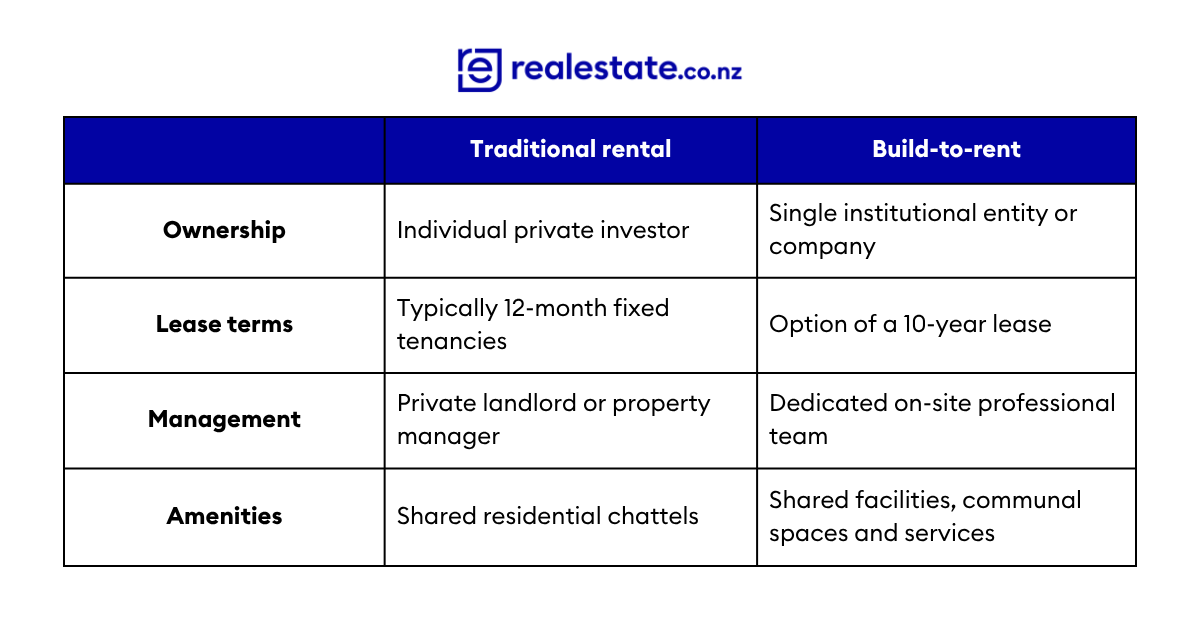
Build-to-rent (BTR) refers to multi-unit residential developments purpose-built specifically for long-term rental housing rather than individual sale. Instead of individual apartments being owned by separate private landlords, the entire complex is held by a single entity, such as an institutional investment fund, community housing provider, or corporate property developer.
Residents in build-to-rent developments usually receive longer leases, flexible tenure terms, and access to shared amenities like on-site maintenance, communal workspaces, and clear pet policies. This model addresses common rental market pain points by creating security of tenure and consistent building management.
What are the tax advantages of build-to-rent? #
Qualified build-to-rent developments receive tailored tax treatment under New Zealand law to encourage long-term institutional investment. These assets were granted an exemption from the earlier interest deductibility restrictions, allowing qualifying developments to claim 100% interest deductions on ongoing financing.
Additionally, legislative provisions support overseas commercial capital participation. Qualifying build-to-rent projects can use a streamlined consent pathway under the Overseas Investment Act (OIA), making it simpler for institutional capital partners to fund large-scale developments.
Key differences for property investors #
Choosing between existing properties and new construction requires reviewing several critical factors:
- Deposit threshold: New dwellings qualify for Reserve Bank LVR exemptions, lowering initial capital barriers.
- Building warranties: New residential builds carry implied warranties under the Building Act 2004, reducing unexpected capital repairs.
- Healthy Homes compliance: Fresh builds are constructed to current insulation codes, saving immediate upgrade expenses.
- Tenancy appeal: Modern layouts, double glazing, and efficient energy designs help attract steady tenant demand.
Frequently asked questions (FAQ)#
Do commercial banks always grant low-deposit loans for new builds?
No, the Reserve Bank sets the regulatory framework, but retail banks retain total control over their lending policies. Banks assess serviceability, applicant income, and project risk before approving a mortgage.
Can private individuals invest in build-to-rent projects?
Most build-to-rent complexes are held by institutional funds and commercial developers due to the significant capital required. Individual retail investors often gain exposure through listed property funds or syndicates rather than purchasing individual titles.
This article is general information only and isn't legal or financial advice. Government eligibility criteria may change. Check the latest requirements before making financial decisions.
Ready to start searching for a new build?#
Explore the latest new builds across New Zealand on realestate.co.nz.