It all starts here: From the dining table to one of NZ’s biggest podcasts
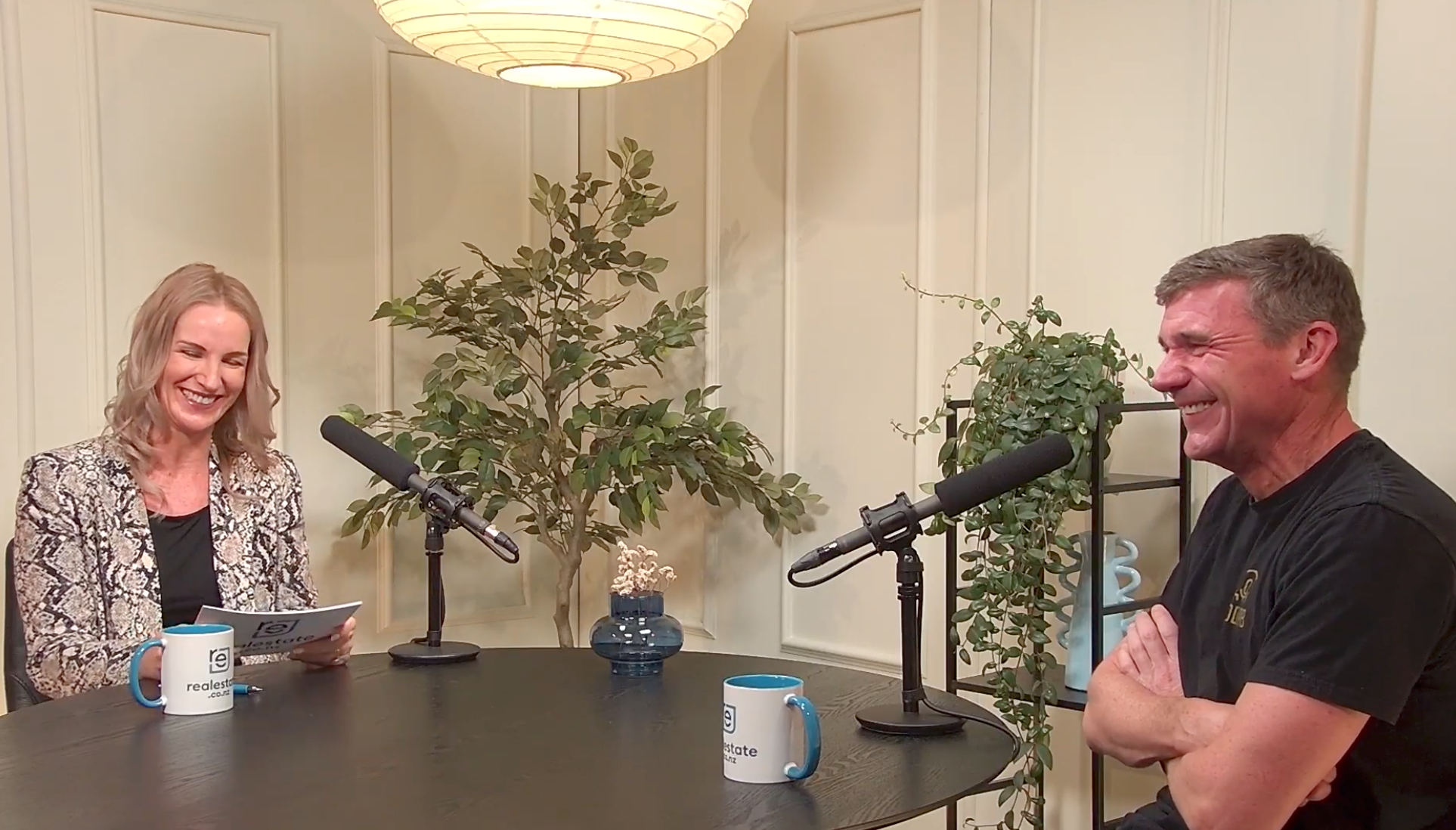
Dom Harvey's award-winning podcast didn't start in a studio. It started at his dining room table, with about $1,500 of gear and no real plan beyond wanting better conversations than the ten-minute radio slots he'd spent two decades doing. In this conversation with host Vanessa Williams, Dom talks about that leap from The Edge breakfast show into long-form interviewing, the shift from playing a shock jock character to just being himself and how, even after more than 300 interviews, being a guest on a podcast terrifies him!
In this episode of It all starts here, Dom sits down with Vanessa Williams, GM - Customer at realestate.co.nz, to talk about growing up in Palmerston North, getting onto the property ladder young, starting his podcast at his dining room table and why, for him, home has always been about much more than property.
Highlights: #
- Starting the podcast at his dining table, welcoming celebrities into his home and a water-blasting fail with Mitch James.
- Trading ten-minute radio slots for two-hour conversations, because, in his words, it's hard for someone to hide their true character for two hours.
- Growing up in a Palmerston North house that always smelled like the previous owners' homemade jam.
- “Even without a clear plan or a clear goal, if you start something and just keep going, it's amazing where you end up.”
- Moving from that dining table into his own studio as co-owner of PodLab, four and a half years and 300-plus interviews later.
Dom Harvey opens up about leaving radio, finding his voice in long-form podcasting and why being a guest still makes him nervous.
A childhood home you never really forget#
Dom spent much of his childhood in Palmerston North. His family lived in a three-bedroom, one-bathroom house, with his parents in one room, his two sisters in another, and Dom and his brother sharing the third.
Looking back, he’s amazed at how many people fitted into the space.
But what stands out most isn’t the size of the house. It’s the memories attached to it.
Dom can still remember the layout, where the light switches were and even the number of steps into the sunken lounge. When he returns to Palmerston North, he likes to run past the houses where he grew up – although they seem to get smaller every time.
One of Dom’s strongest memories is the distinctive smell of one family home: homemade jam.
He remembers returning from holidays and noticing the smell as soon as he walked through the door. Decades later, he’s convinced he’d recognise it instantly.
There were less idyllic memories too – including the regular broken window caused by cricket games on the driveway.
But even those mishaps have become part of the story of home.
The first step onto the property ladder#
Dom’s relationship with property started young.
At just 22, he bought his first home in Palmerston North for $96,000.
It was a three-bedroom stucco house with a garage and a sleepout, and it needed some work. At the time, Dom wasn’t earning enough to comfortably meet the bank’s lending criteria, but he was able to make the numbers work by taking in flatmates.
It meant getting onto the property ladder much earlier than many of his peers.
For Dom, though, home ownership wasn’t simply a financial goal. It was something he had wanted for as long as he could remember.
“I always just had this in the back of my mind that home ownership was something I wanted,” he says.
He also learned some practical lessons from that first property – particularly about knowing when to do things yourself and when to call in the professionals.
Why New Zealanders are so fascinated by property#
Dom’s early interest in property might sound unusual for a teenager, but he’s quick to point out that he was reading property publications from around the age of 14.
He jokes that it was a little odd for a teenager to be reading the property pages, but perhaps it speaks to something deeply ingrained in New Zealand culture.
Property is something we talk about at barbecues, follow in the news and compare notes on with friends and family.
And Dom still has a very Kiwi property habit: when friends buy a house, he admits he’ll go online to see how much they paid – particularly if they’re being secretive about the price.
The home that money can’t buy#
So, if Dom won Lotto, what would his dream home look like?
His first answers are suitably extravagant: perhaps a loft apartment in New York or a villa in Bordeaux.
But when he thinks about what he actually wants, the answer is much closer to home.
Dom describes a large property in Auckland where family and close friends could live together – almost like a private compound.
His parents and siblings would be nearby, there would be communal spaces for everyone to spend time together, and he’d have his own private wing to retreat to when he wanted some peace and quiet.
It’s an interesting vision because it reveals something important about what makes a dream home a dream home.
It isn’t necessarily the biggest house, the most expensive suburb or the most impressive architecture.
For Dom, it’s proximity to the people he loves, combined with enough space to maintain your own sense of privacy.
Starting small – and seeing where it leads#
His award-winning podcast started around four and a half years ago at home, on the dining room table.
There was no elaborate studio or big production team. He bought around $1,500 worth of equipment, set up some microphones and used his coffee mug to prop up his phone for video.
The podcast has since grown significantly, but Dom says the experience taught him something valuable: you don’t necessarily need a perfect plan before you start.
“If you start something and just keep going, it’s amazing where you end up,” he says.
It’s a philosophy that could apply just as easily to property.
Your first home may not be your forever home. It may need work. It may not be in your dream suburb. It may involve flatmates, compromises and plenty of learning along the way.
But it can still be the place where the next chapter begins.
From houses to homes#
A house can be a first step onto the property ladder. It can be a renovation project, a place to raise a family or a way to support an ageing parent.
But ultimately, it becomes a home because of what happens inside it.
As Dom’s story shows, sometimes the things we remember most aren’t the features listed in a property advert at all.
They’re the people, the routines, the smells, the mishaps and the moments that happened there.
Because it all starts at home.
If Dom's dining-table beginnings prove you don't need a studio, or a plan, to start something big, follow It all starts here wherever you get your podcasts.